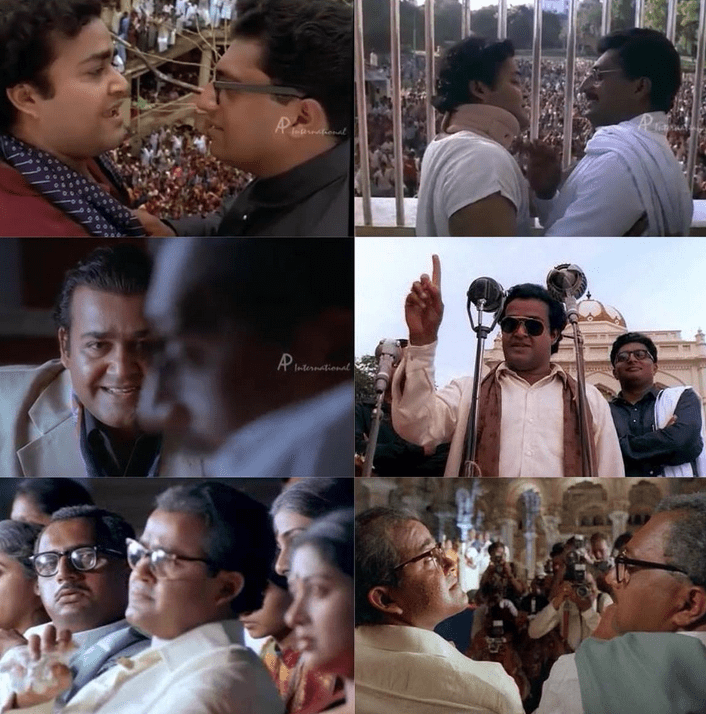
nota bene : this essay was written as a three posts write-up on instagram, 6 years ago, on april 2020.
The title is an obvious clue : Iruvar is rooted in the question of duality. More than that, this theme is reverberated throughout this Mani Ratnam’s chef d’oeuvre which is, in fact, a kaleidoscope of dualities. First of all, the duality between Anandan and Thamizhchelvan. Then, the duality between cinema and politics. Then, the twinning duality between Pushpa and Kalpana. Then, the duality of Anandan and Thamizhchelvan’s love lives : they both get married at the same time, they both have a dual love story as they find solace with another woman than their wife. As I said, a kaleidoscope of dualities.
Yet, the Anandan/Thamizhchelvan’s duo remains the film’s backbone. Indeed, Iruvar is mainly a fictitious reflection of/on the relationship between MGR and Karunanithi from the 1950s to the 1980s. In 158 minutes, Mani Ratnam explores a 4O years friendship from the initial fascinated crush between an actor and a poet to their complex break up, after both embraced polical life. So, obviouly, their omnipresent duality is framed so repetitively throughout the film that the duo it self is kaleidoscopic in the whole film : they hug, they join hands, they see each other in the other one’s eyes.
Behind the mirroring effect in these frames, there is, however, a reversed symmetry, which is a main trait of Anandan and Thamizhchelvan’s relationship : they are the same and they are different ; they unite as friends and they split as opponents. Thus, the scene depicting their first meeting is the matrix of their duo and one of the most beautifully staged and written pieces of the film. Anandan, chosen as the kathanayakan of a new movie, comes to the majestuous but empty film sets. Like an excited child in his favourite playground, he tries the royal throne, he becomes a sword fighting prince, he is the king of his own imaginary kingdom. The joy of being someone else, the joy of playing, the joy of creating stories in this empty but oneiric film set. What a beautiful metaphor of cinema, isn’t it ? Above all, this scene presents the reversed symmetry between Anandan and Thamizhchelvan. Anandan, dressed in white, is innocent, idealistic, childlike. Thamizhchelvan, dressed in black is mature, a grown up and distant poet. Anandan behaves like a fanboy who is happy to meet a famous writer : “neenga ezhuthalar Thamizhchelvan illai ?” (You are Thamizhchelvan, isn’t it?), he says before clapping for the writer’s good words. Thamizhchelvan, on his side, behaves like a composed intellectual who evaluates Anandan through his white dress and his religious superstitions. Thus, this manichean black and white opposition, a leitmotiv in Tamil cinema (Nayagan, Kaala etc etc, you see?), is fundamental in this duo formed by a budding artist and a young intellectual. It’s summed up with this question of Thamizhchelvan, which sounds like an augur of their destinty : “Indha padathu kata-nayakan, anbukkoriya nanban’a, illa madhippukkuriya edhiriyaa?” (Will the film hero be a loving friend or a respectable opponent ?).
However, despite their differences, Anandan and Thamizhchelvan have something in common : they both are dreamers. The enthusiast actor dreams of cinema and fame, the materialist socialist intellectual dreams of political change and an utopian new society. “Ungal thamizh, en nadippu” (Your tamil, my acting), says Anandan, who is already planning for their collaboration, showing that the innocent actor hides in fact a visionary. A visionary who is going to threaten the intellectual himself. That’s why this scene is so beautiful : it’s the meeting of two interweaving dreams, the meeting of cinema and politics.
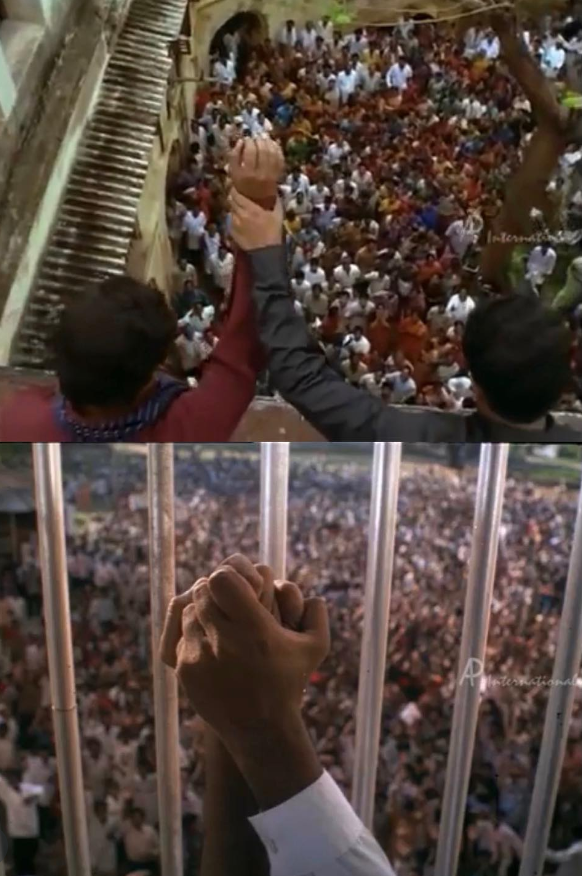
Iruvar is about the confluence of two dreams : Anandan’s dream of cinema and fame, on the one hand, Thamizhchelvan’s dream of materialistic socialism and political utopy, on the other hand. Then, their encounter also gives birth to a common dream : changing society through cinema. Even though Anandan is the one who initiates this project when they first meet, Thamizhchelvan quickly becomes the one who theorizes it and takes charge of its concrete realization. In this famous scene where he presents Anandan to the jubilant crowd as a prince to his future kingdom, he clearly enunciates his strategy : the star actor has the power to reach people’s hearts, so all that matters is to project his face on the silver screen and to exploit the fame given by cinema for their party’s principles. Thus, to reach political power, the actor and the poet join hands, figuratively, and literally on screen. Indeed, first, for the scene I just mentioned and then, for the pre-intermission sequence (after Anandan got shot), Mani Ratnam made a similar aesthetic choice : in both scenes, Anandan and Thamizhchelvan are framed from the back ; in both scenes, hands that symbolize political power are in the foreground while people who are the political aim appear as a spectral but vibrant presence in the background ; finally, in both scenes, the same background music is used. Furthermore, these scenes are eye-opening as well as metaphorical of their relationship : Anandan’s hand reveals hesitation or physical weakness while Thamizhchelvan’s hand makes purposeful and instructing moves. Indeed, he raises Anandan’s hand and then, lets him salute the crowd by himself in the first scene while he makes a similar move to finally firmly join hands with his friend in the second scene. Thus, gradually, Thamizhchelvan, who has a sway in Anandan’s decisions, shows that he wants more, he wants to share the power and popularity of his beloved friend and yet-to-be rival.
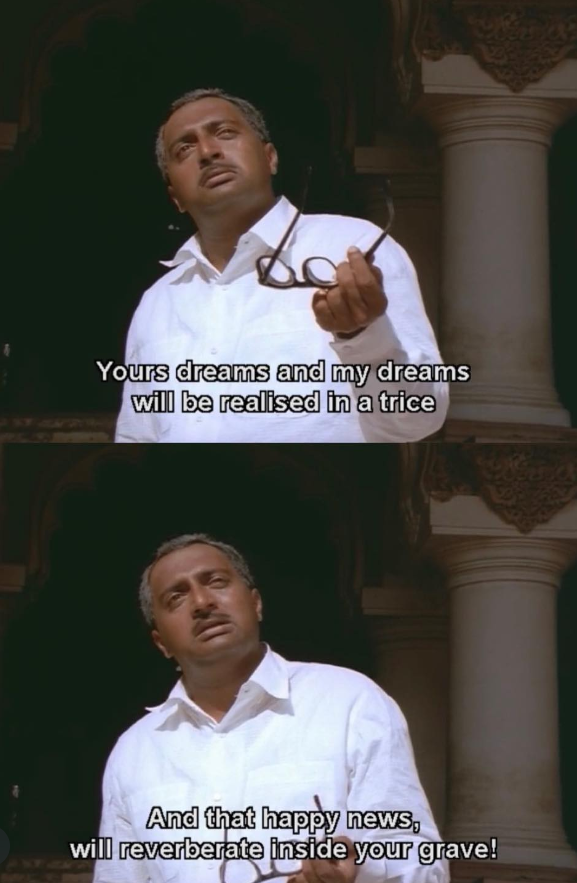
Thus, Iruvar appears to me as this dream of unity, this desire of fusion between these two friends. That’s what the bereaved and desperate Tamizhchelvan cries in the movie’s climax, with a poem (written by Vairamuthu) which is like an intimate funeral oration to his departed friend, but also the last words we heard when the film ends.
.
« Ennaru thozhane, idhayathu nanbane.
Manikka mazhaya, maraindhu vittaya ? (…)
Nam kangal vevveru, kanavugal ondrudhaan.
Nam nenjam vevveru, ninaivugal ondrudhaan.
Nam kottaigal vevveru, kozhgaigal ondrudhaan »
.
But here lies the tragedy of Anandan and Thamizhchelvan’s friendship. They were each other soulmates and they dreamt of unity, but this dream vanishes as soon as they had to establish their own political identity. I always felt and I still feel that more than a faithful biopic of MGR and Karunanidhi, Iruvar is a tragic tale of an impossible union, the chronicle of a friendship’s death foretold, to paraphrase Gabriel Garcia Marquez’s novel, the reel story that blossomed in Mani Ratnam’s mind to explain this legendary but untransparent real duo. In his final oration, Thamizhchelvan has no other choice but hope that their dreams will come true and that they will unite one day, beyond death :
.
« Innoru ponneram ennai thedi vandhaal.
Kaalam oru sengolai yen kaiyil thandal.
Un kanavum, en kanavum oru pozhudhil niraiverum.
Un kallarayin kaadhugalil nalla seidhi arangerum »
.
The more I see Iruvar, the more I think that the film is not only about the duality between these characters, but also about their own inner duality. Indeed, what is fascinating with this movie is the metamorphosis of these two friends/rivals in a 40 years span of life : Anandan is an innocent young actor who becomes Tamil Nadu’s Chief Minister, Thamizhchelvan is an idealist poet who forges himself as one of the main thinking heads of Tamil Nadu’s politics. Of course, there is a very coherent circularity in both character’s arcs (…)
.
In the first frame just as in the final frame, the actor Anandan appears as a face in a close-up shot, this face that defines him as an actor and as an icon. In his first appearance just as in his last appearance, Thamizhchelvan is defined by his words, his voice, this bewitching voice that defines him as a poet and as politician. Circularity, as I said. However, they have not remained the same person as power conquest has not only corrupted their dream of unity but also changed them deeply. Obviously, duality defines their relationship but it also defines their artistic and political persona. Be it acting, speeches or political game, it’s maybe all about putting a mask on.
fin.
shakila zamboulingame
 1916 / about tamil cinema